Those of us who work in software all spend countless hours grinding away on our laptops to push bits and bytes around. We get set in our ways. We use the tools we are given. We get the job done. Many of us could benefit from a few “dev hacks” – kind of like “life hacks” that you see in short-form media, but for developers (or engineers or whatever kind of software title you bear). Here’s a list of dev tips that have helped me, and that I hope can help you.
#1. Buy a laptop case for your stickers
Stickers are like tattoos for inanimate objects, and the greatest canvas for dev stickers is the dev laptop. The only problem is that when the laptop goes, so too go the stickers. If it’s a corporate laptop, then IT department will curse you for making them scrape the stickers off.
What’s the solution? Buy a laptop case, and put your stickers on the case instead of directly onto the machine. That way, you can easily remove the stickers whenever you want! You could even turn old cases into wall art. Laptop cases are typically inexpensive, so there’s no reason why not to buy one.
Here are my laptop stickers on a hard plastic case:
#2. Use Excalidraw for nice diagrams
Excalidraw is an online diagraming tool that is easy to use and makes beautiful diagrams. It is free to use, and you can pay-to-win with advanced features. I use it all the time. It’s incredible. Check it out:
#3. Invest in a decent audio/video setup
Ever since the COVID shutdowns, everybody has virtual meetings. You need to dial in, appear on camera, and speak on a microphone. You might as well look good and sound good while doing it. It’s more professional, and others will subconsciously think more highly of you. So, what should you get?
What you need
What I use
A high-quality USB microphone with a boom arm
Blue Yeti
A 4K webcam
MacBook Pro webcam / Sony ZV-1
Dual desk lights, angled downward
2 x Elgato Key Light
Noise-cancelling headphones
Sony WH-1000XM5
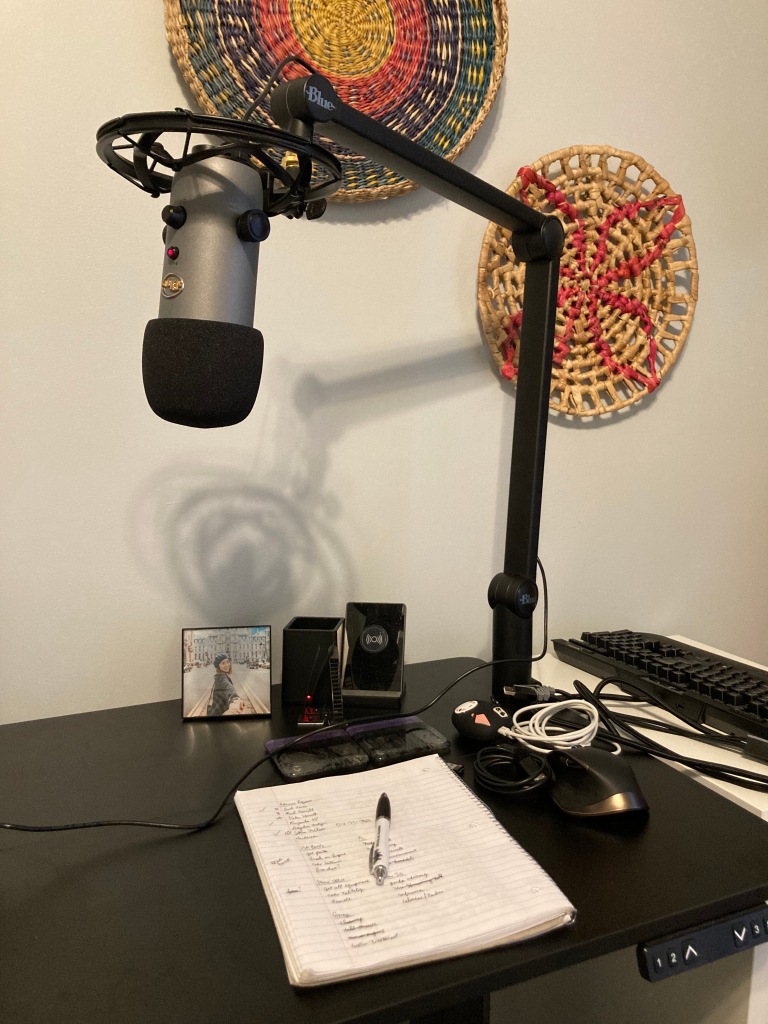
Here’s my setup:
Also, use those headphones to listen to some Lo-Fi music while working!
#4. Keep your snacks and drinks close
When you’re in the flow state, you do not want to be interrupted. Don’t let your hunger or thirst be an interruption. Keep a stockpile of your favorite snacks and drinks within arm’s reach. You could hold a stash of Reese’s peanut butter cups in a drawer. You could put a coffee machine on your desk. I keep a mini-fridge stocked full of Cheerwine, Ito En green tea, and Liquid Death cans in my office.
#5. Become part of tech community
Joining a tech community is one of the best ways to level up your skills. You will meet awesome people and become inspired by the ideas they share. I know I wouldn’t be the Panda I am today if I didn’t get involved in the Python community and the Testing community. There’s a big difference between being a user of a technology and being part of the community for the technology. Go find local meetups for tech that interests you. Attend a conference. Contribute to open source projects. Put yourself out there!
I received a DM through X today from someone claiming to be an Amazon seller asking me to review a set of “adult products” in exchange for “prepaid compensation.”
I joined Twitter back in 2017 to join the “Tech Twitter” community. It was awesome! I connected with so many colleagues, kept up with all the latest developments, and learned so much.
Ever since Elon took over, X has degraded. My feed is polluted with the man himself and all the politics that come with him. Many of my friends and followers have left. I constantly receive spammy messages from crypto bros and catfishers. Today’s DM is a new low. I can’t justify using X for professional purposes anymore.
I’m moving to Bluesky. I’ve already been there for a while. Join me and the rest of Old Tech Twitter. 🦋
When I was a little boy, I wanted to be an engineer when I grew up.
That’s right, I wanted to be a locomotive engineer! Like all little boys, I absolutely loved trains. I watched all the episodes of Thomas the Tank Engine. I wore a striped blue-and-white railroad cap everywhere. And I wanted to grow up to be the guy in charge of the trains.
More than once, my parents took me to see the Chattanooga Choo Choo in Chattanooga, Tennessee. To me, the vibrantly-painted steam engine was just the coolest thing ever. I’d climb into the engine bay (which was allowed) and imagine how much fun it would be to drive it. I don’t remember much of anything from that young age, but I vividly remember pictures in my mind of the Choo Choo.
I actually did grow up to become an “engineer” – just not the kind of engineer my four-year-old self would have expected. This week, my software engineering journey brought me back to Chattanooga on a customer visit. My hotel was located right next to the old train station housing the famous Choo Choo, so, of course, I paid it a visit. It was just as I had remembered it: charming, nostalgic, and iconic. Oh, how I yearn to build things that become as cherished and enduring as the Chattanooga Choo Choo.
Our dreams may not always manifest as we expect, but I am grateful for all the opportunities I have been given and for all the incredible experiences they have brought. Even though my current job title is “Product Management,” I still identify as an engineer at heart: building solutions to tough problems. Never let go of the things that inspire you.
Picture this: It’s 2010, and I’m fresh out of college, eager to dive into the software industry. Little did I know, a simple interview question would challenge not only my knowledge about testing but also my instincts.
Job openings were hard to find in the wake of the Great Recession. Thankfully, I landed a few interviews with IBM, where I completed a series of internships over the summers of 2007-2009. I was willing to take any kind of job – as long as it involved coding. One of those interviews was for an entry-level position on a data warehouse team in Boston. I honestly don’t remember much from this interview, but there was one question I will never forget:
How do you know when you’ve done enough testing?
Now, remember, back in 2010, I wasn’t the Automation Panda yet. Nevertheless, since I had experience with testing during my internships, I felt prepared to give a reasonable answer. If I recall correctly, I said something about covering all paths through the code and being mindful to consider edge cases that could be overlooked. (My answer today would likely frame “completeness” around acceptable risk, but that’s not the point of the story.) I’ll never forget what the interviewer said in reply:
Well, that’s not the answer I was looking for.
Oh? What’s the “right” answer?
If you write roughly the same number of lines of test code as you write for product code, then you have enough coverage.
That answer stunned me. Despite my limited real-world experience as a recent college graduate, I knew that answer was blatantly wrong. During my internships, I wrote plenty of code with plenty of tests, and I knew from experience that there was no correlation between lines of test code and actual coverage. Even a short snippet could require multiple tests to thoroughly cover all of its variations.
For example, here’s a small Python class that keeps track of a counter:
class Counter:

  def __init__(self):
    self.count = 0

  def add(self, more=1):
    self.count += more
There are three times as many lines of test code as product code, and I could still come up with a few more test cases.
In the moment, I didn’t know how to reply to the interviewer. He sounded very confident in his answer. All I could say was, “I don’t think I agree with that.” I didn’t have any examples or evidence to share; I just had my gut feeling.
I sensed my interviewer’s disappointment with my response. Who was I, a lowly intern, to challenge a senior engineer? Needless to say, I did not receive a job offer. I ended up taking a different job with IBM in Raleigh-Durham instead.
Nevertheless, this exchange taught me a very valuable lesson: trust your instincts. While I didn’t land the job that day, the encounter left an indelible mark on my approach to problem-solving. It instilled in me the confidence to question assumptions and trust my instincts, qualities that would shape my career trajectory in unforeseen ways. Never dismiss your instincts because you are less senior than others. You just might be right!
Have you ever attended a developer conference? Or maybe you’ve taken a software product tutorial? Perhaps you’ve listened to a tech podcast, or you follow someone with an avocado emoji 🥑 on Twitter? Chances are that the folks behind lots of that content are involved in Developer Relations.
Many software companies run Developer Relations (or “DevRel”) practices these days. They might go by different names, such as Developer Advocacy, Developer Experience, or Developer Evangelism, but what do folks in DevRel actually do? There’s a lot going on behind the posts and public appearances. In this article, I want to share insights I’ve gained from my time as a Developer Advocate for Applitools.
What’s the main purpose?
The main purpose of Developer Relations is to bridge company and community:
It helps the community understand the value of the company’s technology and how to start using it.
It helps the company understand the community’s needs and facilitates the community’s feedback.
More specifically, DevRel focuses on the community of developers – the practitioners who will actually use the technology. In fact, many DevRel folks like me are developers ourselves. We seek to serve our own communities. Our job is not to sell the C-suite on buying products and services, but rather to help developers get the most value out of what the company offers. DevRel’s goal could be restated as “making life better for developers.”
With that in mind, it is important for DevRel folks to be authentic. If members of the community feel like DevRel is merely sales in disguise, then they will flatly ignore DevRel. Any work DevRel attempts to do will be in vain.
Me, a Developer Advocate, giving a talk at All Things Open 2022 in Raleigh, NC.
How’s it done?
Saying that DevRel “bridges company and community” sounds very abstract. DevRel encompasses several activities to accomplish that purpose. For example, in my job as a Developer Advocate:
I speak at public conferences and company events.
I write articles about software testing, automation, and quality.
I develop tutorials for my company’s SDKs.
I deliver workshops on test automation and on visual testing.
I talk with customers to learn the challenges they face with testing.
The types of duties done by DevRel naturally cluster around distinct roles. DevRel is a team sport, and it is rare that one person will be highly skilled at all the different roles, let alone have enough time to fulfill them. There are six primary roles that make up a DevRel team.
The Evangelist
The evangelist popularizes the technology in an authentic, helpful way. Their job is to make sure people in the community know the big picture. Thus, the evangelist is a very outwardly-focused role. They make many public appearances at events, and they develop loads of content, like videos, articles, and online courses. Travel and strong social media presence are practically required for the job. Since they are on the “front lines,” they also keep their ears open for any feedback they might hear about the technology or the company. Evangelists may be considered thought leaders and influencers.
Since evangelists are so active in their communities, it’s common for them to have large followings on Twitter, LinkedIn, and YouTube. They may even become somewhat of celebrities in their spaces. More attention on them brings more attention to the companies they represent. Celebrity status must be handled carefully, though. One bad tweet can ruin a reputation. Or, if a company builds their entire DevRel program on one evangelist’s high profile, then the program could collapse if that person ever leaves the company.
The Educator
The educator teaches members of the community how to use the technology. While the evangelist may give introductions and demos, the educator teaches the finer details. Typically, they write product documentation, quickstart guides, and tutorials. They may even teach courses online or in person. The educator must have strong skills in technical writing and education. In fact, in many DevRel practices, educators transitioned into tech from academia! The educator does not need a high profile like the evangelist. They can be more behind-the-scenes if they choose.
My friend Sarah and I giving a BDD tutorial in person at STARWEST 2022 in Anaheim, CA.
The Community Builder
The community builder fosters scalable relationships with those using the technology. They drive and sustain engagement with the community. A good community builder creates an environment where everyone feels a sense of belonging. They provide a space for organic interactions, vulnerable questions, and helpful camaraderie. For example, folks should be able to ask basic product questions in a Slack room or product forum and get helpful answers from others in the community.
The “scalability” of those relationships is rooted in the programs the community builder runs, such as:
Building a public communication forum (like Slack, Discord, or Discourse)
Hosting events and spaces for folks to gather
Providing newsletters or product updates
Connecting folks together for cool opportunities
Furthermore, the community builder provides front-row seats to what’s happening with the technology. They get folks excited for upcoming features, new releases, and the possibilities for the future. They could provide early access to beta versions of features or hold release parties. In doing so, the community builder also solicits feedback from the community to help make the technology even better.
The Advocate
The advocate uses their expertise and community feedback to build better user experiences into the technology. In a sense, advocates are the opposite of evangelists. While evangelists are focused primarily on pushing information out from the company to the community, advocates work in the other direction, bringing feedback from the community into the company.
Specifically, advocates make feedback actionable. They work with product teams to improve the technology. They might even develop changes themselves! Sometimes, advocates are called “developer experience engineers” to emphasize how good DX (developer experience) doesn’t just happen – it must be built.
The Platform Builder
The platform builder creates the systems and infrastructure that maintain DevRel programs. They are essentially developers whose customers are other DevRel folks. For example, the platform builder could:
Create example projects for demos and educational material
Build, deploy, and administer documentation websites
Keep package versions for tutorials and example projects up to date
Implement the infrastructure needed for big events like a hackathon
The platform builder is very much behind-the-scenes and oftentimes the unsung hero.
The Visionary
The visionary casts the vision for the company’s Developer Relations practice. They lead with big ideas, set goals, and guide the team to success. Usually, the visionary carries a title like “director” or “head.” Since a DevRel practice could encompass so many different kinds of activities, they need to be wise in how they align resources to meet their goals. For example, if the company is a startup that’s just starting to roll out early releases, then the visionary should probably focus most on evangelism and community building. Different companies will have different needs.
Developer Relations work can require lots of travel. Try not to miss your flights!
How do these roles work together?
As I stated previously, DevRel is a team sport! Here’s an example of how these six roles could work together for a program like Test Automation University:
The visionary notices that folks are struggling to use the company’s technology, so they decide to create an online learning platform with free courses about the technology.
The platform builder develops the web app for the learning platform and deploys it to cloud resources.
The educator creates training courses and uploads them to the learning platform.
The evangelist promotes the learning platform when they speak at events and post on social media.
The community builder welcomes new students to the learning platform, sets up a Slack room for them to ask questions, and makes announcements when new courses are published.
The advocate finds ways to improve courses, such as adding completion progress visuals as students complete chapters.
These roles have some overlapping responsibilities, but they clearly represent distinct areas of responsibility.
Where does this team belong?
From what I’ve seen, most Developer Relations teams fall under one of two organizations: Product or Marketing. Indeed, DevRel has responsibilities to both. DevRel activities happen at the top of the marketing funnel. The team should work close with marketing folks on messaging. At the same time, DevRel folks must be somewhat independent of sales and marketing in order to be authentic in the community. They should focus on good, valuable content that supports the product and genuinely helps their users. Ultimately, the parent organization will ultimately determine how a DevRel team’s performance is measured.
One way to measure DevRel success is how many people take your stickers!
How should success be measured?
The impact of Developer Relations is tough to measure because it benefits so many aspects of a company. It teaches folks about the company’s technology. It draws them into the marketing funnel. It provides helpful guides to get them started. In many instances, though, it’s hard to measure how one particular conference talk encouraged someone to sign up for a free account, or how one piece of vital documentation prevented a user from rage-quitting.
Overall, the best measure of success is engagement. The more engaged people are in the products and in the community, the more likely they are to pay for more. Here are a few engagement metrics to consider:
How many active users the products have and how they use them
How many people sign up for an account after an event
How many people visit certain blog articles or documentation pages
How many stars, forks, and watchers a GitHub project has
The completion rate for tutorials and courses
There are many other things that could be measured. Just remember that no single metric tells the full story.
Does DevRel really matter?
YES! Developer Relations matters as a practice because developer experience (DX) matters for the consumption of technology. It’s the 2020s. People don’t want to use lousy products. Developers expect tools and services to work well while solving their problems. DevRel is critical for building bridges with developers. It helps them understand why your fancy new tech is worth their consideration, and it helps you as a company understand what they need and what delights them.
Let’s face it: working in software is tough. I’ve worked in software for over a decade, and I’ve learned a lot of things during my journey – oftentimes the hard way.
On April 7, 2022, I tried something new: every hour for 24 hours, I tweeted a lesson I learned during my software career. I covered topics like breaking into the industry, working on projects, and seeking advancement. I used the hashtag #PandyEveryHour to track my tweets. I started at 8am (US Eastern) on April 7, and I concluded at 8am on April 8. It was an awesome experience: lots of folks liked, retweeted, and commented. Some of my insights struck nerves.
In case you missed it while my tweets went live, I compiled all the tweets below in order. Give them a read! If you like any of them in particular, be sure to “like” them on Twitter so I know!
⏰ IT'S PANDY KNIGHT EVERY HOUR! ⏰
Every hour for the next 24 hours, I will tweet important lessons I've learned throughout my software career.
You'll meet lots of people throughout your software journey. Most of them will be good, but some will be jerks.
Seek good, wholesome influences. Surround yourself with folks who build you up and inspire you. Avoid those who tear you (and others) down.#PandyEveryHourpic.twitter.com/U4v6Fk21Ek
1⃣ Write a "topic sentence" comment stating *what* the code will do. 2⃣ Write a few lines of code to implement that intention. 3⃣ Separate paragraphs with blank lines
I don't care how "bad" you are at testing. Just do it. You gotta learn somehow.
Lamest excuse I ever heard: "We didn't test because it wasn't a requirement." Really? Don't make others suffer from your mistakes. Care about your quality.#PandyEveryHourpic.twitter.com/ckzVvQc5Mm
Rewriting something from scratch is rarely the right solution. Just because you didn’t write it doesn’t mean it’s “wrong.”
As engineers, we relish the idea of building our own things. Business, on the other hand, doesn't like reinventing wheels that still roll.#PandyEveryHourpic.twitter.com/BYKPrd5g3e
😕 A JUNIOR engineer enjoys figuring out code. 😀 A SENIOR engineer enjoys writing code. 😈 A STAFF engineer enjoys deleting code. 😢 A PRINCIPAL engineer misses coding.#PandyEveryHourpic.twitter.com/AhERiOdBkK
You might think that technical challenges are the hardest part of a software job. FALSE!
The hardest part is usually working with people. Everyone has objectives and opinions. We all gotta play the game. Do so with honor.#PandyEveryHourpic.twitter.com/fltHBWgIom
One time, a teammate accidentally deleted the remote main branch. They came to me, we restored it, we put a security policy on it, and nobody else had to know.
💆 Some people express opinions based on wisdom. 🗣️ Others express opinions based on arrogance. 🤔 Learn to discern the difference. 👀 Be cautious when detangling the two.#PandyEveryHourpic.twitter.com/EKFeS6ikeH
📃 It records your knowledge and skills 📃 It can help other people 📃 It shows others that you are smart 📃 It won't get locked behind proprietary walls 📃 It helps you hone communication skills
You will get better promotions and raises if you switch companies.
😱😱😱
You'd think companies would want to promote their own talent, but many are stuck in annual perf cycles w/ little more than cost-of-living raises.#PandyEveryHourpic.twitter.com/Mtt6aVDoH6
At my new job as Developer Advocate at Applitools, I now permanently work remotely. Working from home is new to me. At my previous company PrecisionLender (later acquired by Q2), I worked in an office that was a seven-minute drive from my house. My office was a real office: an enclosed room with a door, walls, a large desk, and two huge whiteboards. Working from the office was a joy. We had free snacks and sodas. My colleagues and I all got along great, and we’d go out to lunch almost every day. After COVID-19 hit the USA in March 2020, I was heartbroken to abandon the office. I was so stubborn about eventually returning to the office that I refused to set up a decent workstation at home. For a year and a half, I worked exclusively on my laptop either from a desk in my living room or from the couch – no monitors, no mouse, and no separate keyboard. I mean, come on, the pandemic would be over in a few short months, right?
However, my attitudes about remote work are changing. At PrecisionLender, I was spoiled with the best kind of office situation someone could have. Many others in the software field are not so fortunate. Those who live in the big cities like New York and San Francisco pay thousands of dollars a month to split tiny apartments and spend an hour or more on one-way commutes. Not to mention, many of them move away from family and friends to take those opportunities.
Office layout trends in recent years have also been dismal. The open layout – no walls with clusters of desks sloppily smashed together – is the norm. Perpetual audio and visual distractions are a nightmare for anyone trying to concentrate. Widescreen monitors and noise-cancelling headphones only help a little. I experienced that frustration at MaxPoint and LexisNexis. Cubicles, while passé these days, are only a small step up from open floors. While the “walls” block out visual distractions, you can still hear everything that goes on around you. Plus, the enormous blocks of cubicles on a floor feel brutally confining. I frequently called the IBM 500 complex in RTP “Cubicle City” when I worked there.
Remote work can be a godsend for many hardworking folks who just want to do a good job while doing right by themselves. Folks, especially in software, can literally work anywhere. COVID-19 shutdowns have proven it. My wife and I even took advantage of it: we bought a vacation condo in Seattle, and I worked remotely from there for several weeks. I could automate tests during the day, grab beers with close friends, and catch a Mariners game on the weekend. Even with a 3-hour time zone difference, I was right in step with my team the whole time.
My Seattle condo building’s rooftop
Recently, I saw a Twitter thread by Chris Herd in which he made several predictions on remote work in 2022 and beyond:
I've spoken to 3,000+ people about remote work in the 2021
This thread really resonated with me. While I still have some concerns about remote work, I do believe it will be a net good for not only my country and people but also for the world. I’d like to highlight some of the points he made that really stuck out to me.
🚜 Rural Living: People will move to smaller cities, have a lower cost of living & higher quality of life
These regions must innovate quickly to attract that wealth. Better schools, faster internet connections are a must
I agree completely with this, and I’m excited to see it happen. The US has so many awesome places, from sea to shining sea. There’s no reason why someone should need to move from their hometown to a big city just to work for a specific company (unless, of course, they want that adventure). Places like Raleigh-Durham, Nashville, Denver, Miami, Pittsburgh, Salt Lake City, Cleveland, and countless other smaller American cities are fantastic places to live. Each has a unique vibe and local specialties. Allowing folks to live where they want with good employment opportunities will rejuvenate local and regional economies. It will bring broader prosperity to all.
This is happening already. The Triangle of NC, where I live, is booming. My wife and I rent local listings on Airbnb, and all through the pandemic, the #1 type of guest we’ve hosted by far is someone interested in relocating to the Triangle.
⏰ Asynchronous Work: Offices are instantaneous gratification distraction factories where synchronous work makes it impossible to get stuff done
Tools that enable asynchronous work are the most important thing globally remote teams need. A lot of startups will try to tackle this
I hadn’t thought about asynchronous work until Chris mentioned it, but he’s right. Life is 24/7, and people live all around the globe. Remote work can liberate us from a harsh 9-5 and instead embrace more flexible hours. For example, this past week, I had to work around the clock for a few days prepping a big webinar. However, I wasn’t working for 16 hours straight each day. I woke up a bit late, did some light administrative activities before lunch, hit it hard all afternoon, stopped for dinner and time with my puppy, and then burned the midnight oil after dark. That’s what worked for me.
⚽️ Hobbie Renaissance: Remote working will lead to a rise in people participating in hobbies and activities which link them to people in their local community
This will lead to deeper, more meaningful relationships which overcome societal issues of loneliness and issolation
Yes! I’m living it myself. My wife and I just adopted a French bulldog puppy, and I also started restoring a vintage 1970 Volkswagen Beetle.
I swapped the engine out of my vintage 1970 Volkswagen BeetleSuki the French bulldog is the cutest puppy in the world!
🌍 Diversity & Inclusion: The most diverse and inclusive teams in history will emerge rapidly
Companies who embrace it have a first-mover advantage to attract great talent globally. Companies who don't will lose their best people to their biggest competitors
This one is so ironic. Based on many articles I’ve read, upper management seems to despise work-from-home because they think their workers will work less. However, all the good, hardworking folks I know are actually working more than ever. Not only are folks more efficient, but they tend to keep working just a little extra because there are fewer barriers between work stuff and personal stuff. In my new job, I know I’m certainly working more hours right now than I probably should, and I’m hoping to settle into a more sustainable routine as I acclimate to my new role. Nevertheless, we absolutely need to protect ourselves against unintentional burnout.
✈️ Remote Retreats: purpose built destinations that allow for entire companies to fly into a campus for a synchronous week
Likely staffed with facilitators and educators who train staff of how to maximize effectiveness
One big concern I have with remote work is the loss of in-person contact. Humans need to be around each other, and screens are a poor substitute. I know I’ve felt lonelier working from home than when I worked in an office. That’s why I absolutely love this idea about regular remote retreats. Companies can still bring folks together, and they can hire professionals who know how to maximize that time. I go to software conferences frequently for similar experiences.
❤️ Life-Work Balance: The rise of remote will lead to people re-prioritizing what is important to them
Organizing your work around your life will be the first noticeable switch. People realizing they are more than there job will lead to deeper purpose in other areas
I think this goes hand-in-hand with async work. However, unless safeguards are put in place to prevent overworking, then life-work balance could quickly become work-more-work imbalance.
💩 Bullshit Tasks: The need to pad out your 8 hour day will evaporate, replaced by clear tasks and responsibilities
Workers will do what needs to be done rather than wasting their trying to look busy with the rest of the office
Honestly, this one was never much of a problem for me. The only “paddings” I’ve had in my workdays are long, boring meetings where I participated little. Thankfully, those were confined mostly to my days at IBM and NetApp earlier in my career.
🧘♀️ Health & Wellbeing: A lack of commute will give workers 25 extra days a year to do other things
Workers will exploit the freedom they have to organize things more freely in their day. Afternoon runs, morning meditation, 2 things a lot of people I know now do
YES! Even though my commutes have always been relatively short, I still appreciate the time I get back in my day. Here are some things I’ve done with my extra, more flexible time:
Sleep in a little later
Play with my puppy when I need a break
Share lunch nearby with friends
Run a quick errand in my Beetle
Grab an impromptu bubble tea with my wife
Take a walk around my neighborhood while thinking about work-related challenges
✍️ Written over spoken: documentation is the unspoken superpower of remote teams. The most successful team members remotely will be great writers
Companies are searching for ways to do this more effectively. Tools that enable others to write better will explode
Documentation is the unspoken superpower of remote teams. I strongly value written communication for its clarity, searchability, and permanence.
Chris had lots of other good tweets in that thread, so be sure to read them. Overall, his tone was bullishly optimistic on remote work – not only in its benefits, but also in its inevitability. Personally, I hope remote work is here to stay, and that it’s not just a phase brought on by the COVID-19 pandemic. It’s a game-changer for individuals and industries alike. However, I’m still somewhat fearful that big companies will reign in wide scale returns to the office after the pandemic. Giants have already sunk millions to billions in commercial real estate for their offices that they can’t get back. I’m also worried about salaries in different geographies. Employers already pay folks who live outside of big cities much less for the same work due to cost-of-living differences. I don’t think that will be fair as people leave big cities in droves for smaller cities or the countryside. Already, the cost of living is skyrocketing in the Triangle, yet our average tech salaries are far below those of Silicon Valley. We’ll see what happens.
Overall, I am optimistic about remote work just like Chris.
So, what do y’all think? Please leave comments below. I’d love to learn different perspectives!
I have awesome news to share: I’m now a Developer Advocate at Applitools! I’m pumped for my new role. Watch my video announcement below for all the details.
I’ve always been frustrated with poor quality audio recordings. Microphones built into laptops are very convenient, but they usually yield tinny sound lacking the depth of real voices. When I asked my audiophile friends for advice, they recommended studio-level equipment that was beyond my comprehension and my budget. As a software guy, I just wanted an audio setup that captured high-quality audio while still being convenient for everyday usage. I’d need it for remote meetings as well as for recording talks and tutorials. I was willing to pay for good equipment as long as I could use it well. Unfortunately, my biggest frustration was ignorance. I didn’t know anything about recording.
When I did my research, the Blue Yeti microphone was at the top of everyone’s recommendation list. The nicest thing about a Blue Yeti mic is that it connects via USB. You simply plug it right into your laptop and select audio input and output channels. The mic doesn’t need an external power source, either.
Initially, I bought only the Blue Yeti mic and the foam windscreen. Instead of using the boom arm, I used the tabletop stand that came with the mic for all my recordings. This was a big mistake. The tabletop stand picked up a lot of local noise, like typing on a keyboard. The audio quality it picked up also sounded like it had a bit of an echo, which may have been due to sound bouncing off the tabletop or my hardwood floors.
The boom arm and shockmount made a huge improvement in recording quality. Plus, with the boom arm mounted firmly to my desk, I can easily move it towards me for recording or out of the way otherwise. It feels quite sturdy. I chose to use all Blue products so that I could be certain that they’d work together. You can save quite a bit of money if you buy the microphone, boom arm, and shockmount together as a bundle on Amazon (~$200), instead of a la carte like I did (~$250).
My audio recording setup: a Blue Yeti microphone mounted onto a Blue Radius III Shockmount dangling from a Blue Compass boom arm. Pardon the mess on my desk – it’s a work in progress!
I plan to get a docking station for my laptop so that I can plug the microphone’s USB cable into the dock, simplifying desk’s cable management.
Even with this new setup, I still felt like I didn’t understand how to use my Blue Yeti microphone to its full potential. Thankfully, YouTube came to the rescue! This video greatly helped me understand things like tuning the mic’s gain and positioning the mic while speaking:
In summary, here’s what I like about the setup:
It yields very good (maybe professional?) audio recording quality.
It is simple enough for anyone to set up and use.
It is convenient to use for remote meetings, video recordings, etc.
It feels quite sturdy.
It is relatively affordable (compared to other audio equipment).
Please note: I am not an expert in audio equipment, and this article is not sponsored by any company. I simply hope that someone can benefit from the things I learned (and possibly save a few bucks) if they want to improve their own recording game!
Happy Global Testers Day! For 2021, QA Touch is celebrating with webinars, games, competitions, blogs, and videos. I participated by sharing an “upside-down” story from years ago when I accidentally wiped out all of NetApp’s continuous integration testing. Please watch my story below. I hope you find it both insightful and entertaining!



 Automation Panda